

Humidification vs filter-based air purifiers in industry
Humidification is not just about regulating the level of moisture in the air in factories and other workplaces. It’s also extremely effective at removing dust from the air, and generally has many advantages over air cleaners with filters.
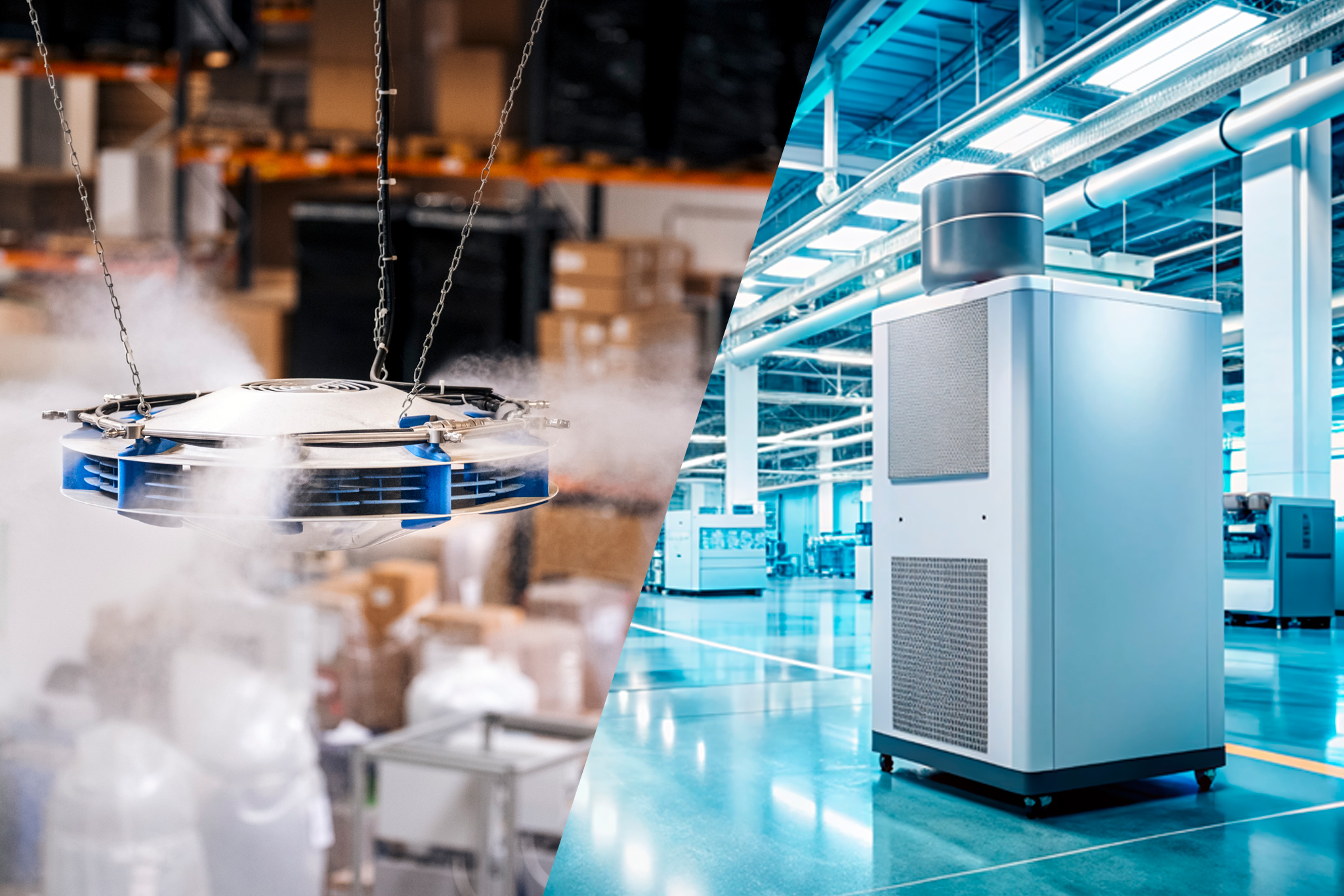
Filter-based air purifiers or cleaners (also called dust boxes or filter boxes) can work to remove particulate matter, but have major drawbacks and shortcomings compared to humidification systems. When it comes to noise levels, power consumption, space usage, maintenance, function and efficiency, the Merlin® humidifiers can often be a much better alternative.
Fundamental differences
Filter-based air purifiers
- Draws air from the room
- Dust is lifted into the air
- Transported through space
- Captured (partially) in filters
Adiabatic humidification systems from Merlin Technology
- Binds dust where it occurs
- Prevents dust from becoming airborne
- Reduce spread before it happens
Prevention vs aftercare
Documented weaknesses of air purifiers
Based on industrial tests, HSE experience and practical use (confirmed by the Norwegian Labor Inspection Authority and professional environments), filter-based air cleaners have several disadvantages:
1. Dust is drawn up into the breathing zone
- Filter boxes must move air to function
- This lifts dust from floors and work surfaces
- Increases exposure in the breathing zone before filtration
→ Poor HSE for workers close to the dust source.
2. Limited effect on coarse and heavy dust
Designed primarily for:
- Fine particulate matter
- General air quality
Less efficient on:
- Concrete dust
- Demolition dust
- Metal and mineral dust
→ Dust settles in the room before the filter has time to catch it.
3. Point solution – not process solution
First and foremost, it cleans the air where the box is located.
Has little effect on:
- Dust that occurs continuously
- Mobile work processes
- Large or open premises
→ Does not cover actual dust production.
4. High noise
An air purifier uses large electric fans as gears:
- Continuous airflow
- Audible noise often above 60-70 dB
→ Poor working environment, especially during prolonged use.
5. High maintenance needs
The use of filters implies:
- They need to be changed often
- Handled as hazardous waste
- Reduced power when filter is saturated
→ Increased operating costs and downtime.
6. No effect on tool wear
Dust remains airborne before filtration and enters the:
- Power tools
- Machinery
- Control units
→ More frequent need for service, shorter service life, more downtime.
Advantages of humidification (fogging)
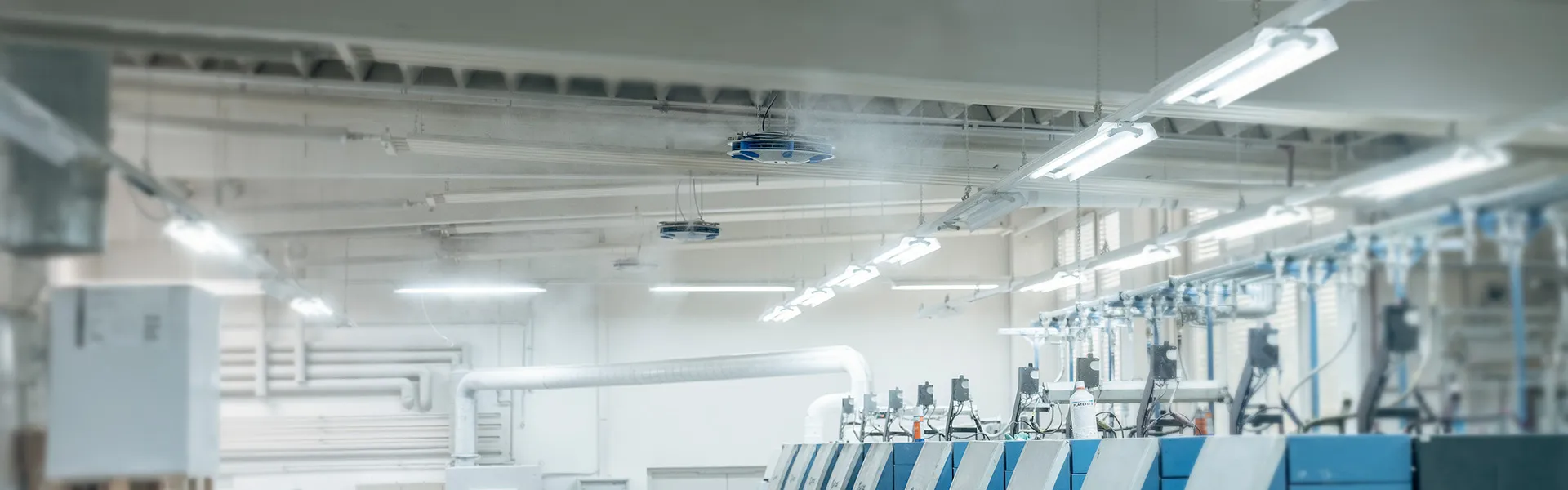
1. Capture dust before it becomes a problem
- Dust particles moisten and become heavy
- Falling down locally
- Does not spread in the room
→ Real dust control, not just “cleaned air”.
2. Better HSE and health
Less particulate matter in the breathing zone means:
- Fewer respiratory problems
- Reduced risk of long-term injuries
- Less need for masks
→ Great value for workers who stand in dust every day.
3. Extend the life of tools and machines
- Less dust in the air
- Less dust entering engines, bearings and electronics
→ Lower service costs and less downtime.
4. Almost noise-free operation
- No large fans
- No air transport
→ Better working environment than filter boxes.
5. Controlled moisture – not wet
Humidification systems use micro atomization of water as:
- Binds dust
- Evaporates quickly
- Allows precise humidity control
- Provides adiabatic cooling
→ Optimal humidity and temperature without the room getting wet.
6. Low energy consumption and high sustainability
- Pumps and controls only
- No large engines
- No filter waste
→ Lower energy and environmental footprint.
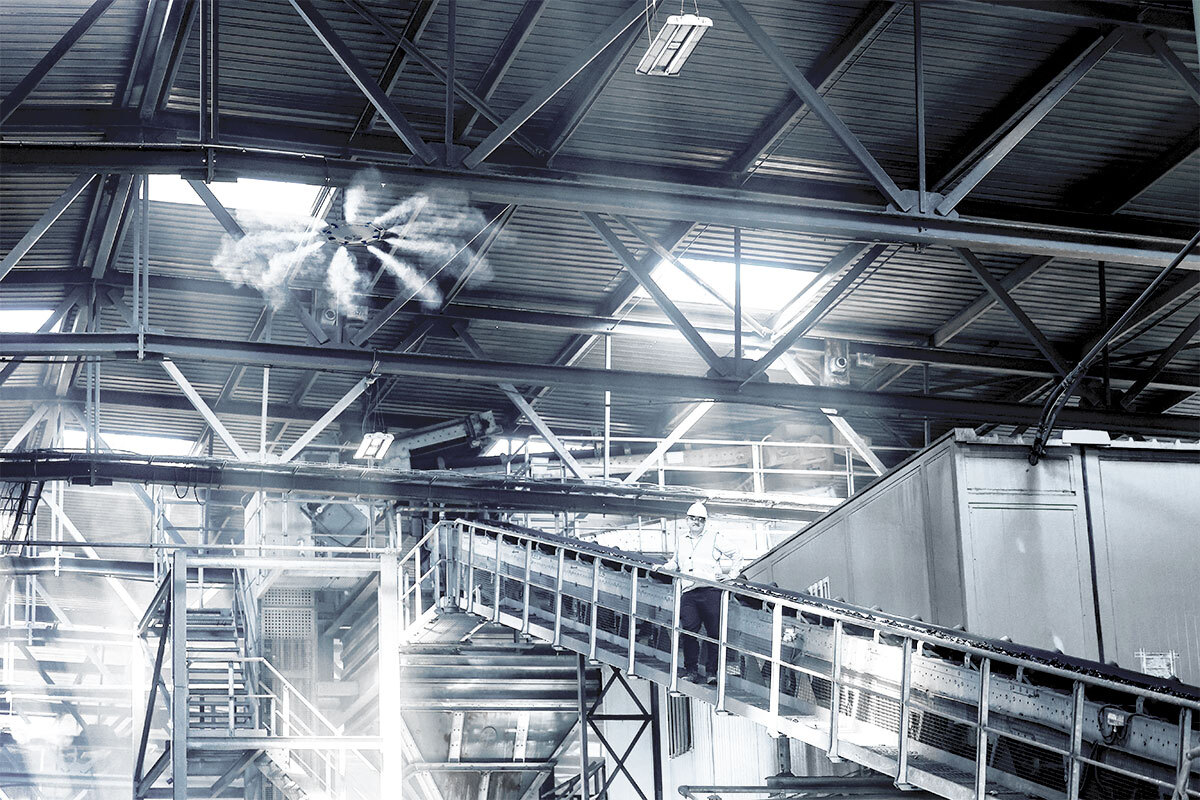
Filter boxes often provide a false sense of security
It ‘s important to point out that with a filter-based air purifier, the dust is pulled past people and objects before it can be collected. The air is cleaned, but the dust has already been breathed in, spread around the room and drawn into tools. In addition, this increases static electricity which is unfortunate in many manufacturing processes.
This doesn’t happen with humidification, where the dust instead binds to water particles and sinks straight to the ground. Humidification attacks the problem where it occurs.
In a nutshell
| Air purifier | Humidification | |
| Principle | Traps dust after spreading | Prevents spreading |
| HMS | Limited | Very good |
| Noise level | Hay | Very low |
| Maintenance | High | Low |
| Tool wear and tear | No effect | Significantly reduced |
| Sustainability | Filter waste | Low consumption |
Are you ready to optimize your work environment with better indoor climate and cleaner air?
Klimabefuktning AS will assess which measures are best suited to your company and offer customized solutions for all stages of production.
Get in touch with us to get started!
Source: https://www.arbeidstilsynet.no/arbeidsmiljo/inneklima/ventilasjon