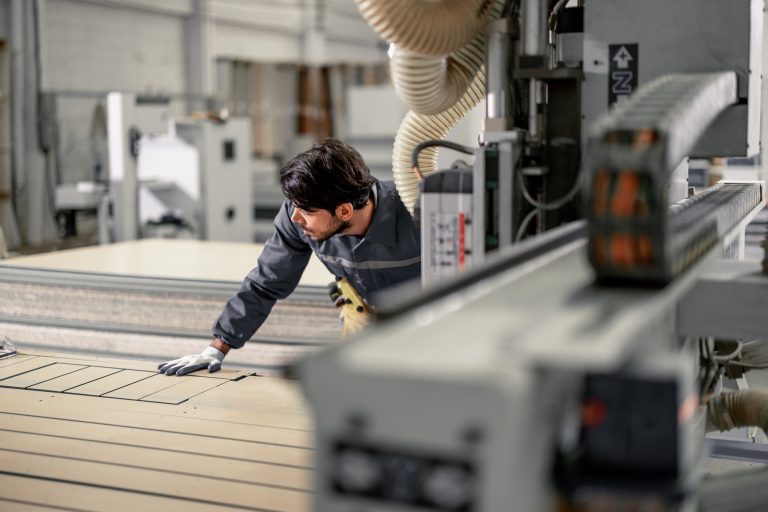



How humidification can reduce odors in industrial environments
Odor problems are a common challenge in many industries. Production processes can generate odors from materials, chemicals, organic dust, waste and hot processes. This can affect your working environment, local area and reputation.
Many people associate humidification primarily with humidity control, but a properly dimensioned humidification system can also be a very effective method of reducing odor in industrial environments.
Why do odor problems occur in industry?
Many industrial processes cause small particles, gases or organic compounds to be released and break down in the air. Combined with open sources and inadequate cleaning or process control, this can lead to an unpleasant working environment.
In factories, these are the most common reasons:
Organic material decomposes without oxygen and produces gases such as hydrogen sulphide, mercaptans, amines and volatile fatty acids. This is common in the food and fishing industries, the wood industry and sludge treatment.
Open processes, storage, leaks and compost and waste treatment often lead to pungent odors. This also applies to the storage and drying of wood that emits terpenes, aldehydes and other volatile organic compounds (VOCs).
High temperature, incorrect pH, contamination, mixing errors and frost in treatment plants can increase the occurrence of airborne particles.
In dry environments, such particles are more likely to remain suspended in the air and spread over large areas.
How low humidity contributes to odor
When humidity is low, several things happen that exacerbate the problem:
The result can be increased odors in production facilities and in the surrounding area.
How industrial humidification can help
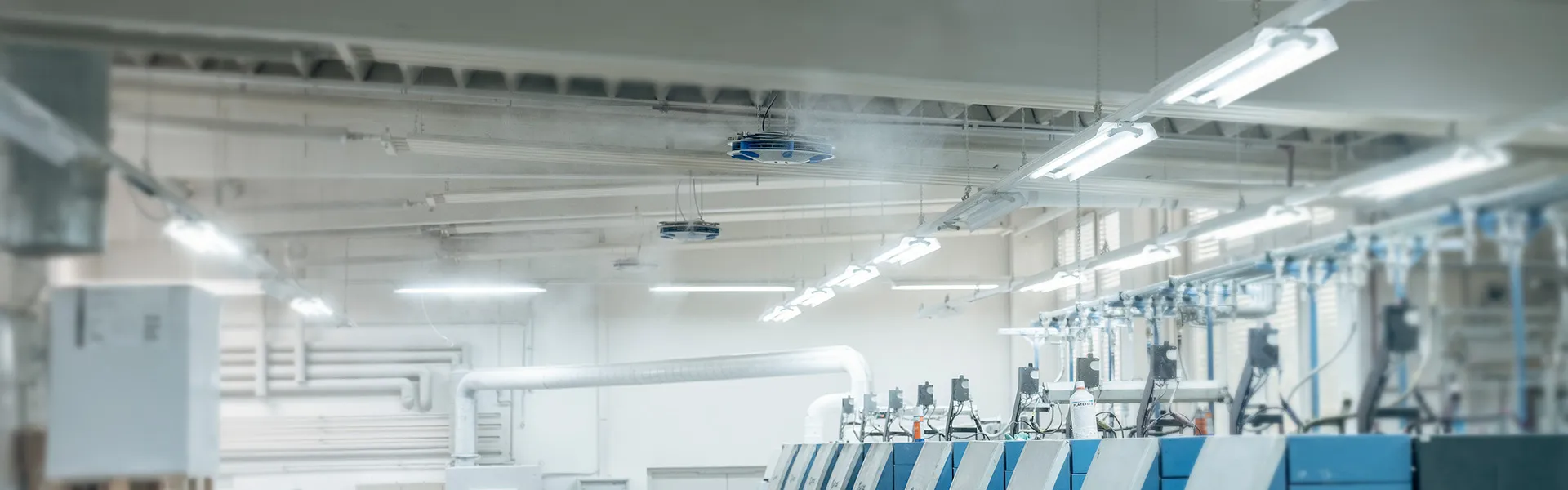
A humidification system adds very fine water droplets to the air. These act as natural “particle traps”.
The effect of correctly dimensioned humidification is:
The microscopic water droplets capture dust, particles and aerosols. When these bind to moisture, they become heavier and fall more quickly to the ground, where they can be removed via cleaning or ventilation.
When the amount of dust is reduced, the spread of particles is also significantly reduced.
The right humidity reduces evaporation of volatile compounds and contributes to a more stable and controlled production environment.
Humidification nozzles can be strategically placed in areas where odors occur, capturing particles before they have time to disperse.

Where is odor-reducing humidification used?
Humidification is an effective solution in a number of different industries:
More benefits with humidification
In addition to reducing odor, proper humidification also provides:
As a result, the business gains both environmental and operational benefits.

An efficient and environmentally friendly solution
Modern humidification systems, such as our Merlin® solutions, use very fine water particles and involve minimal energy consumption. It’s a natural and chemical-free way to cost-effectively control odor, dust and indoor air quality in industrial environments. Read more about Dust binding and odor reduction.
A better working environment – and better surroundings
Odor problems not only affect employees, but also neighbors, customers and reputation. By investing in the right humidification, industrial companies can create a cleaner, more stable and more comfortable environment both indoors and outdoors.
Controlled humidity is therefore not just about comfort – it’s an important tool for environmental control, efficient operations and sustainable production.
Do you want to know more about how humidification can improve your work and production environment?
Contact us for a non-binding assessment.
Relevant research articles: